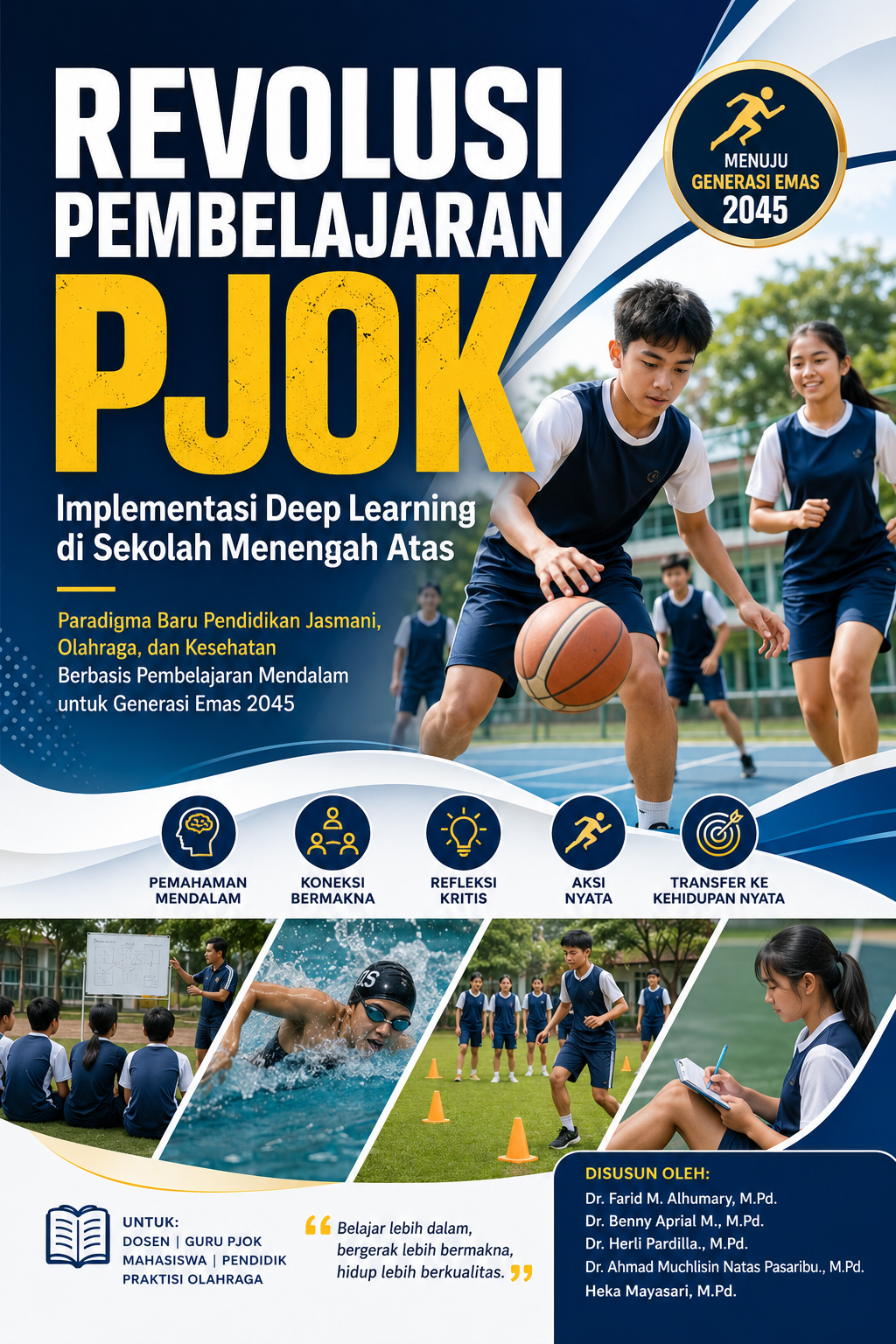
REVOLUSI PEMBELAJARAN PJOK : Implementasi Deep Learning di Sekolah Menengah Atas
Authors
Farid M Alhumary, Yan Indra Siregar, Mahmuddin, Zikrur Rahmat, Suryadi Damanik, Heka Mayasari, Ahmad Muchlisin Natas Pasaribu, Herli Pardilla, Benny Aprial M M, Muhammad Isnandar ()Files
Key Information
Journal
Published in 2026 of CV. Langit Kita Publishing.
CV. Langit Kita Publishing merupakan penerbit buku ber-ISBN yang berkomitmen mendukung pengembangan ilmu pengetahuan, pendidikan, penelitian, dan inovasi melalui penerbitan karya ilmiah yang berkualitas. Didirikan sebagai lembaga penerbitan profesional, CV. Langit Kita Publishing hadir untuk menjadi mitra strategis bagi akademisi, dosen, guru, peneliti, mahasiswa, praktisi, serta institusi dalam menerbitkan karya-karya ilmiah yang memenuhi standar nasional maupun internasional.
About the JournalAbstract
Buku ini mempersembahkan paradigma transformatif dalam pembelajaran PJOK melalui konsep deep learning. Mengintegrasikan teori Piaget, Vygotsky, Kolb, Self-Determination Theory, dan temuan Hattie dengan konteks pendidikan Indonesia, buku ini menyajikan kerangka komprehensif dari konsep dasar hingga implementasi praktis. Dilengkapi studi kasus nyata, contoh RPP, LKPD, rubrik penilaian, dan panduan penelitian tindakan kelas, buku ini menjadi referensi esensial bagi dosen, guru PJOK, dan calon pendidik dalam mewujudkan pembelajaran jasmani yang bermakna dan transformatif.
References
Alhumary, F. M. (2024). Inovasi pembelajaran PJOK di era digital: Model, strategi, dan implementasi berbasis teknologi. Journal of Physical Education and Sport, 24(3), 112–128. https://doi.org/10.7752/jpes.2024.03314
Alhumary, F. M. (2025). Transformasi pedagogi PJOK menuju pembelajaran mendalam: Tantangan dan peluang bagi pendidik era digital. Jurnal Pendidikan Jasmani Indonesia, 21(1), 1–18.
Anderson, L. W., & Krathwohl, D. R. (Eds.). (2001). A taxonomy for learning, teaching, and assessing: A revision of Bloom's taxonomy of educational objectives. Longman.
Arufe-Giraldez, V., Zagalaz-Sanchez, M. L., Cachon-Zagalaz, J., & Gonzalez-Valero, G. (2024). Effects of the teaching games for understanding model on physical education students: A systematic review. Children, 11(1), 42. https://doi.org/10.3390/children11010042
Bailey, R., Armour, K., Kirk, D., Jess, M., Pickup, I., & Sandford, R. (2009). The educational benefits claimed for physical education and school sport: An academic review. Research Papers in Education, 24(1), 1–27.
Biddle, S. J. H., Ciaccioni, S., Thomas, G., & Vergeer, I. (2018). Physical activity and mental health in children and adolescents: An updated review of reviews and an analysis of causality. Psychology of Sport and Exercise, 42, 146–155.
Bunker, D., & Thorpe, R. (1982). A model for the teaching of games in secondary schools. Bulletin of Physical Education, 18(1), 5–8.
Butler, J. I. (2015). Teaching games for understanding as a curriculum model. In K. Green & K. Hardman (Eds.), Physical education: Essential issues (pp. 161–183). SAGE.
Casey, A., & Goodyear, V. A. (2015). Can cooperative learning achieve the four learning outcomes of physical education? A review of literature. Quest, 67(1), 56–72.
Casey, A., Goodyear, V. A., & Armour, K. M. (2017). Digital technologies and learning in physical education: Pedagogical cases. Routledge.
Casey, A., & Goodyear, V. A. (2020). Rethinking teacher education in physical education. In A. MacDonald & G. van der Mars (Eds.), Journey into discourses of physical education (pp. 123–140). Routledge.
Deci, E. L., & Ryan, R. M. (2000). The 'what' and 'why' of goal pursuits: Human needs and the self-determination of behavior. Psychological Inquiry, 11(4), 227–268.
Dyson, B., & Casey, A. (2016). Cooperative learning in physical education and physical activity: A practical introduction (2nd ed.). Routledge.
Entwistle, N. (2018). Student learning and academic understanding: A research perspective with implications for teaching. Academic Press.
Erikson, E. H. (1968). Identity: Youth and crisis. W. W. Norton.
Fullan, M., & Quinn, J. (2016). Deep learning: Engage the world change the world. Corwin Press.
Goodyear, V. A., & Casey, A. (2015). Innovation with change: Developing a community of practice to help teachers move beyond the honeymoon of pedagogical renovation. Physical Education and Sport Pedagogy, 20(2), 186–203.
Hastie, P. A. (2012). The nature and purpose of Sport Education as an educational experience. In P. A. Hastie (Ed.), Student-designed games (pp. 15–30). Human Kinetics.
Hattie, J. (2009). Visible learning: A synthesis of over 800 meta-analyses relating to achievement. Routledge.
Hattie, J. (2012). Visible learning for teachers: Maximizing impact on learning. Routledge.
Hellison, D. R. (2011). Teaching personal and social responsibility through physical activity (3rd ed.). Human Kinetics.
Hardiyanto, S., Prasetyo, Y., & Wulandari, D. (2023). Tingkat aktivitas fisik siswa SMA di Indonesia. Jurnal Kesehatan Masyarakat Indonesia, 18(2), 112–120.
Kementerian Pendidikan, Kebudayaan, Riset, dan Teknologi. (2022). Kurikulum Merdeka: Capaian pembelajaran dan profil pelajar Pancasila. Kemendikbudristek.
Kementerian Pendidikan, Kebudayaan, Riset, dan Teknologi. (2023). Survei nasional praktik pembelajaran PJOK 2023. Kemendikbudristek.
Kirk, D. (2010). Physical education futures. Routledge.
Kolb, D. A. (1984). Experiential learning: Experience as the source of learning and development. Prentice-Hall.
Krathwohl, D. R., Bloom, B. S., & Masia, B. B. (1964). Taxonomy of educational objectives: Handbook II: Affective domain. David McKay.
Malina, R. M., Bouchard, C., & Bar-Or, O. (2015). Growth, maturation, and physical activity (2nd ed.). Human Kinetics.
Marton, F., & Saljo, R. (1976). On qualitative differences in learning. British Journal of Educational Psychology, 46(1), 4–11.
Martone, A., & Sadera, B. (2018). Exploring the attributes of effective classroom teachers. Journal of Teacher Education, 69(2), 140–154.
Miller, A., Christensen, E., Eather, N., Gray, S., Sproule, J., Keay, J., & Lubans, D. (2017). Can physical education outcomes be developed using a game-centered approach? European Physical Education Review, 23(1), 113–133.
Morales-Belardo, A., & Arias-Palencia, N. (2022). The effects of teaching games for understanding: A systematic review. Research Quarterly for Exercise and Sport, 93(2), 243–260.
Palao, J. M., Hastie, P. A., Cruz, A., & Ortega, E. (2015). The impact of video technology on student performance in physical education. Technology, Pedagogy and Education, 24(1), 51–63.
Piaget, J. (1972). The principles of genetic epistemology. Human Development, 15(5), 328–334.
Ryan, R. M., & Deci, E. L. (2017). Self-determination theory: Basic psychological needs in motivation, development, and wellness. Guilford Press.
Siedentop, D. (1994). Sport education: Quality PE through positive sport experiences. Human Kinetics.
Simpson, E. J. (1972). The classification of educational objectives in the psychomotor domain. Gryphon House.
Standage, M., Duda, J. L., & Ntoumanis, N. (2005). A test of self-determination theory in school physical education. British Journal of Educational Psychology, 75(3), 411–433.
Thomas, J. W. (2000). A review of research on project-based learning. Autodesk Foundation.
Tomlinson, C. A. (2017). How to differentiate instruction in academically diverse classrooms (3rd ed.). ASCD.
UNESCO. (2015). Quality physical education: Guidelines for policy-makers. UNESCO Publishing.
Vygotsky, L. S. (1978). Mind in society: The development of higher psychological processes. Harvard University Press.
Wiggins, G., & McTighe, J. (2005). Understanding by design (Expanded 2nd ed.). ASCD.
World Health Organization. (2020). WHO guidelines on physical activity and sedentary behaviour. WHO.